Project GENESiS

THREE PILLARS. ONE STANDARD.
Insight: Understanding deep enough to act on. Not data. Not output. Contextualized intelligence that informs sound judgment.
Integrity: AI that is transparent, unbiased, and explainable. Every conclusion must be traceable. Every process must be visible. If you cannot see how it thinks, you cannot trust what it produces.
Impact: Action that is earned. Insight and integrity must be established before AI is trusted with consequence. When they are, outcomes become meaningful, defensible, and durable.
This is the sequence. This is the standard.
Building Trustworthy AI through Operational Intelligence
Project GENESiS is an applied AI initiative designed to improve organizational reliability, security, and decision quality by starting where risk is lowest, feedback is fastest, and errors are immediately visible, IT operations and cybersecurity.
Rather than beginning with customer-facing or revenue-impacting use cases, Project GENESiS establishes a disciplined operational foundation. It allows AI behavior, accuracy, and failure modes to be observed, corrected, and governed early, before AI is trusted with business decisions that carry irreversible consequences.
Why Project GENESiS Exists
Organizations increasingly look to AI to improve efficiency and decision-making, yet many initiatives fail not because AI lacks capability, but because it is introduced too high in the stack, too early. Business-facing AI errors such as mispricing, incorrect entitlements, flawed eligibility decisions, or service miscalculations can immediately impact customers, finances, and trust. In many cases, those impacts cannot be undone.
Project GENESiS addresses this risk by deliberately anchoring AI in operational domains first. IT environments provide continuous, high-volume feedback loops where anomalies are quickly noticed, system behavior is well understood, and errors are surfaced early, long before they can cascade into business or customer harm.
The Foundational Principle: Start Where Failure is Visible and Recoverable
IT professionals are deeply attuned to how their environments should behave. They recognize when systems slow down, drift, or fail outright. This makes IT operations an ideal proving ground for AI because inaccuracies, faulty assumptions, and unintended behaviors are detected quickly and unambiguously.
When AI is applied at the operational layer, failures tend to manifest as:
~ degraded system performance
~ incorrect alerts or missed detections
~ inconsistent analysis or recommendations
~ operational friction rather than customer impact
These failures are visible, measurable, and recoverable. They can be corrected through tuning, governance, and data refinement without permanently affecting customers, revenue, or service integrity.
By contrast, introducing AI directly into business workflows risks silent failure. An AI system can miscalculate a decision, grant unintended access, mishandle entitlements, or incorrectly optimize a service outcome, often without immediate detection. In these cases, the organization may only realize the error after trust or value has already been lost.
Project GENESiS intentionally avoids this trap.
Operational Intelligence as the Proving Ground for AI Quality
Project GENESiS begins by correlating operational and security signals such as:
~ identity and access activity
~ device and system usage patterns
~ authentication timing and location
~ configuration and behavioral drift
~ workload and demand signals
This serves two purposes simultaneously.
First, it strengthens security and reliability by identifying anomalous behavior, misconfigurations, and instability early.
Second, and equally important, it provides a controlled environment to evaluate AI accuracy itself. False positives, false negatives, bias, and model drift surface rapidly in operational contexts. Project GENESiS allows the AI to be trained, constrained, and corrected before it is trusted with higher-order decisions.
This process systematically improves signal quality and confidence over time.
From Operational Clarity to Business Insight
Once operational data is reliable, contextualized, and well understood, the same signals can be responsibly elevated to support business insight.
Understanding who is active, where work is occurring, when demand peaks, and how systems are actually used enables leadership to:
~ align staffing with real workload patterns
~ identify coverage gaps or overcapacity
~ understand operational shifts and utilization trends
~ correlate internal capacity with external demand
These insights are grounded in validated operational truth, not assumptions or incomplete datasets.
Project GENESiS ensures that by the time AI contributes to business insight, it already has a proven understanding of how the organization behaves under normal, stressed, and degraded conditions.
Agentic AI Built on a Stable Foundation
Project GENESiS supports agentic AI. These systems are capable of planning and executing tasks, but only after foundational accuracy has been demonstrated.
Agentic workflows are introduced incrementally, with:
~ bounded permissions
~ approval checkpoints
~ full auditability
~ rollback and containment mechanisms
~ clear separation between recommendation and execution
When agentic AI is built on a strong operational foundation, outcomes improve dramatically. The AI understands context, constraints, and expected behavior, reducing unintended consequences and increasing trust.
Design Philosophy
Project GENESiS is modular, open, and model-agnostic. It favors open standards and open-source components where feasible, to reduce bias, improve transparency, and allow inspection of how conclusions are formed.
Commercial AI models may be incorporated for conversational interaction and advanced reasoning, while internal analytics emphasize control, explainability, and governance.
The guiding principle is consistent, the right model for the right task, governed by measurable risk and performance.
A Phased, Repeatable Operating Model
Project GENESiS follows a deliberate progression:
Phase 1: IT Operations and Cybersecurity
Low risk, high feedback, rapid learning. AI behavior is validated where failure is visible and recoverable.
Phase 2: Technical Workflow Automation
Repeatable operational tasks are automated under strict controls, with confidence built through consistency.
Phase 3: Business Enablement
Only after data quality, AI accuracy, and governance are proven does Project GENESiS inform or automate business workflows.
This sequence is intentional and repeatable.
What Success Looks Like
Success is measured through outcomes, not aspiration:
~ early detection of AI inaccuracies before business impact
~ fewer operational incidents and faster recovery
~ improved security posture with reduced analyst fatigue
~ high-confidence operational and business insight
~ automation that is trusted because it is earned
~ reduced risk of irreversible customer or financial harm
The Project GENESiS Journey
This represents the foundational stage of Project GENESiS, where organizations begin with discipline, visibility, and control.
AI already has the ability to reshape business outcomes, decision support, and intelligent automation across the enterprise. The question is not whether it can move higher up the stack, but whether organizations are prepared to support that progression. Those that succeed will not be defined by how quickly they adopt AI, but by how well they build the foundation for it to endure.
Reference Architecture
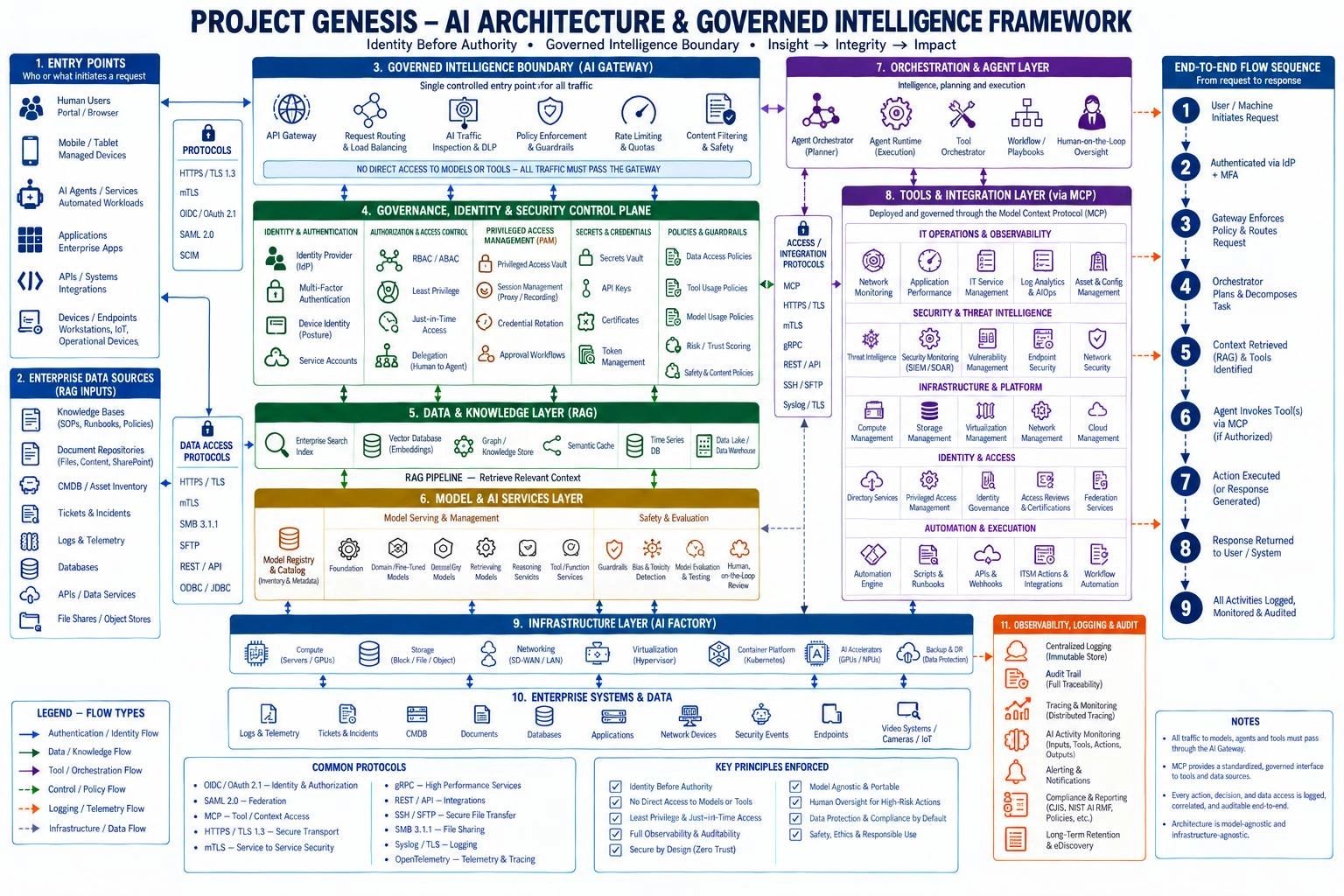
The diagram below provides an illustrative reference architecture for the Project GENESiS framework. It shows how identity and authorization, the Governed Intelligence Boundary, orchestration, models, data, tools, enterprise systems, and observability interact across a governed AI environment.
The architecture is vendor-neutral and technology-agnostic. It is intended to illustrate the framework’s logical components, control points, interactions, and end-to-end flow, not to prescribe a specific product, platform, or implementation.
The diagram was created with the assistance of AI as a visual representation of the framework. The written Project GENESiS framework remains authoritative and should govern its interpretation and implementation.